
Blogs/DIGITAL SOLUTIONS IN AI ERA
22 October 2026·by EKAKA EMMANUEL
DIGITAL SOLUTIONS IN AI ERA
AI isn’t going anywhere, and it won’t replace a developer who knows their craft and has embraced the new tool.
AI is here to stay
AI is not a passing tool. It is part of how digital work gets done now. That does not mean it takes the job of a proficient person. Someone who already understands the problem, the client, and the system still decides what is worth building and what is safe to ship. AI helps that person move. Work that used to take years of drafting, rewriting and waiting can now be brought down to weeks, because the slow parts of typing and searching no longer sit in the way.
The people who lose ground are not the ones who are good at the craft. They are the ones who treat the tool as a replacement for judgement. A proficient developer, analyst or architect uses AI to speed the process and keeps the responsibility.
It is never too late
It is never too late for any developer. Learn, unlearn and relearn the AI tools so that productivity goes up. What you knew last year may need to be set down this year. That is ordinary in this craft. The habit matters more than the starting point: open the tool, try it on real work, drop what no longer helps, and pick up what does.
If you already write software, a new language or framework is rarely a year-long project. A month of focused use is often enough to become useful: you can read the docs, ship a small service, and know where the sharp edges are. That is not mastery. It is enough to stop treating the technology as the main obstacle.
Spend the month on process, not only syntax
The part that does not compress as easily is how work actually moves. How a change is requested, reviewed, tested, released and owned after it is live. How data is classified. How an incident is handled. How a client is told what will and will not be in scope. Those processes decide whether a month of learning becomes a reliable delivery or a pile of clever fragments.
A developer with a programming background should put more time there than on memorising APIs. Frameworks change. The habit of writing a clear acceptance check, keeping a record of decisions, and refusing to ship without a rollback path travels from one stack to the next.
Use AI tools to move faster, and to hold the architecture
This note is written from building with Cursor and Claude models. At the time of publishing, that pairing has been the best tooling from my perspective: the editor stays in the repo, the model can read the files you point it at, and you still decide the architecture. Other tools will move. This is the reference I am using today, not a claim that the market is finished.
Cursor with Claude changes the pace of that month. You can ask for a first cut of a module, a test, or a migration, then spend your attention on whether the result fits the system. Used as a typist, AI only makes more code. Used as a pair that you direct, it lets you stay on structure: boundaries, data flow, failure modes, and what must stay simple.
That only works if you can still make the architecture. The tool does not know the client, the regulator, or last quarter's outage. You do. Prompt for options, compare them, and keep the decision. If you cannot explain the shape of the system without the chat window, you are not developing faster. You are borrowing a design you cannot maintain.
Data privacy when the tools collect data
These tools collect data. A prompt can carry source code, names, amounts, passwords and client files. Once that leaves your machine, you do not control how long it is kept or who can see it. Treat every chat as a transfer of information. Keep secrets out of the window. Strip personal and client records unless the client has agreed. Turn off training on your code where the product allows it. If a file would be wrong to email to a stranger, it is wrong to paste into an assistant.
On that Cursor and Claude setup, pick the model for the job instead of sending every question to the heaviest option. Use a lighter Claude model for routine edits, tests and small refactors. Reach for a stronger one when the design is hard or the codebase is large, not for every rename. Choosing the lighter model also limits how much context you need to attach, which is better for privacy and for cost.
The road leads to solution architects
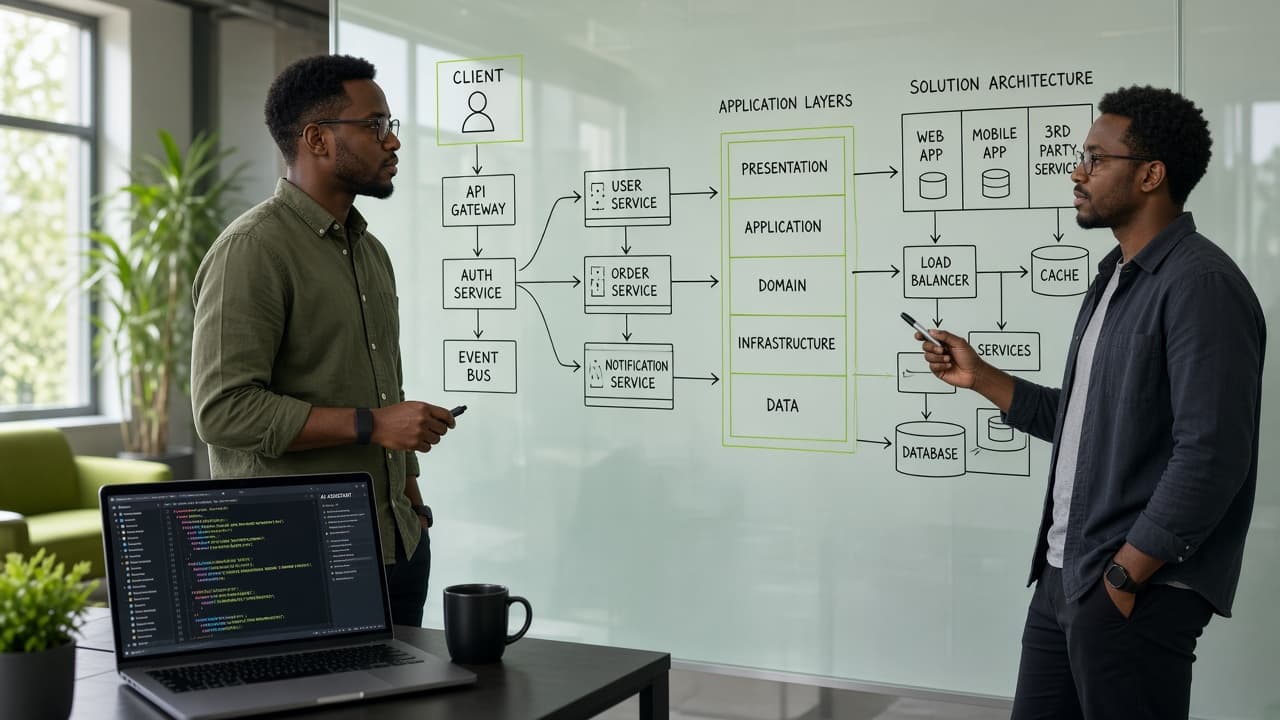
When syntax is cheap and generation is cheap, the scarce skill is judgement: which process to follow, which trade-off to accept, and how the pieces should sit together. That is the work of a solution architect. The path is not away from engineering. It is through it: learn a technology quickly, invest in the processes around it, and use AI so work that once stretched across years can land in weeks, while the design still belongs to people who can stand behind it.
At iArt Solutions that is how we want delivery to feel: automation and analysis that can be audited, with people who still own the architecture. If you are building the same way, or want a partner who will, start from the article list or get in touch.